Google Is Bringing AI Shopping Performance Insights to Merchant Center
For years, ecommerce businesses have had established ways of measuring their visibility in Google.
Search Console shows which searches generate impressions and clicks. Google Analytics shows what visitors do after arriving on a website. Merchant Center provides performance information about products appearing across Google's shopping surfaces.
AI-powered search introduces a new challenge.
If a customer uses Google AI Mode or an AI Overview to research a purchase, how does a retailer know whether its products are being surfaced during that process?
Google is beginning to answer that question with a new set of AI performance insights in Merchant Center.
Initially available as a limited US pilot, with expansion to Australia, Canada, India and New Zealand planned, the reporting provides retailers with information about how their brands and products appear within Google's generative AI shopping experiences.
For UK retailers, this is currently something to watch rather than a report they can expect to find in Merchant Center today.
But the measurements Google has chosen are interesting because they provide an early indication of how ecommerce visibility could be measured as product discovery becomes increasingly conversational.
From search queries to shopping conversations
Traditional ecommerce search often begins with relatively short queries:
men's waterproof jacket
acrylic sheet cut to size
black leather office chair
AI-powered shopping allows customers to be much more specific.
Someone could instead ask:
What is a lightweight waterproof jacket suitable for walking in the Lake District for less than £150?
Rather than matching a few keywords, Google has considerably more context about what that person wants.
According to Google, its new Merchant Center reporting is specifically designed around these more complex conversational shopping journeys.
The report covers organic AI visibility within AI Mode and AI Overviews, with Google also announcing AI shopping measurement across its wider generative AI ecosystem.
This changes the measurement problem.
A retailer no longer just wants to know whether it ranks for waterproof jacket. It may also want to know whether its products are being considered when AI systems answer much more specific questions about waterproofing, intended use, size, material, price or other product characteristics.
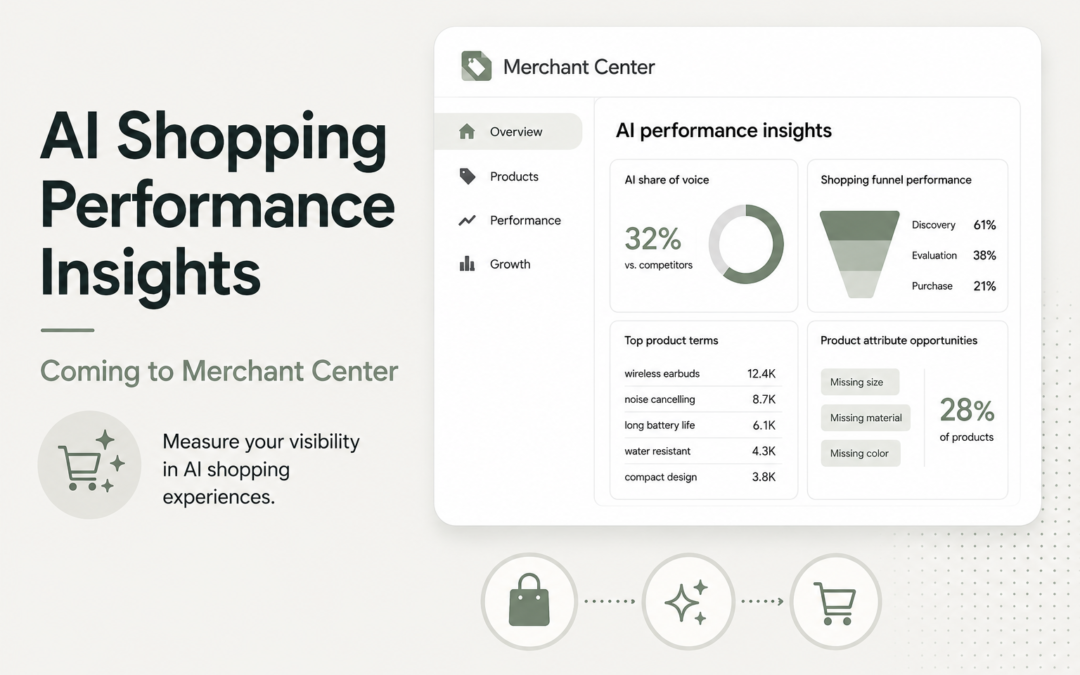
Google is introducing AI share of voice
One of the headline measurements is AI share of voice.
Google defines this as the proportion of relevant AI impressions captured by a merchant's brand or products compared with the merchant and its competitors.
Merchant Center will also provide the average share captured by the competitor set Google has identified.
This potentially gives retailers something that has been difficult to establish until now: a benchmark for their visibility within AI-generated shopping results.
A business might discover, for example, that it performs strongly in conventional Google results but has a relatively low share of visibility when customers use conversational searches involving particular product features.
That would raise a useful question:
Why is Google comfortable recommending competing products in those situations but not ours?
The answer may not simply be traditional rankings.
It could involve the quality and completeness of the product information Google has available.
Measuring different stages of the shopping journey
Google is also separating AI shopping activity into three stages:
- Discovery – when customers are exploring possible products.
- Evaluation – when customers are comparing products or researching specifications.
- Purchase – when the query indicates someone is closer to buying.
This is potentially more useful than treating every AI appearance as equivalent.
Consider two questions:
What type of flooring is best for a busy kitchen?
and:
Where can I buy 20 square metres of waterproof oak-effect flooring for delivery this week?
Both could involve products sold by the same retailer, but they represent very different levels of purchase intent.
Understanding where a business appears within that journey could eventually help retailers identify a different type of visibility problem.
A retailer might perform well when customers are ready to purchase but rarely appear during initial product research.
Another might have strong visibility during research but disappear when shoppers begin comparing specifications.
AI visibility therefore may not eventually be represented by one score. It could become something that needs to be understood across the entire purchasing journey.
Product terms provide another layer of insight
Google is also reporting the product terms appearing frequently in AI shopping conversations.
These aren't necessarily traditional search keywords.
They can describe the features or benefits customers are looking for.
Google gives examples such as:
maximum cushioning
and:
arch support
Merchant Center can show how frequently particular terms are being used, how many of a retailer's products match them and the retailer's corresponding share of voice.
That could be particularly valuable for ecommerce businesses.
Keyword research traditionally tells us how people search.
AI shopping data could increasingly tell retailers which characteristics customers are asking AI systems to use when selecting products.
That is a subtle but important difference.
Product attributes may become increasingly important
Perhaps the most interesting part of Google's announcement concerns product attributes.
Merchant Center's AI performance reporting can identify popular structured attributes customers are looking for, such as:
- size
- colour
- material
- other relevant technical specifications
It can then highlight where these attributes may be missing from a retailer's product data.
This creates a much clearer connection between product-data quality and AI visibility.
Imagine that customers frequently ask Google for a product made from a particular material.
A retailer sells exactly that product, but the material isn't properly represented in its product data.
Humans visiting the website might still be able to work it out from the description.
An AI shopping system has a more difficult decision to make.
If another retailer explicitly provides the required attribute, that product may provide a clearer match for the customer's request.
This is why I think product information will increasingly need to be considered part of ecommerce marketing rather than simply catalogue administration.
Product data is becoming measurable marketing infrastructure
This is one of the wider implications of Google's announcement.
Historically, ecommerce optimisation has often separated marketing from product administration.
SEO teams optimise pages.
Advertising teams manage campaigns.
Merchandising teams manage products.
Someone else maintains the product feed.
AI-powered shopping increasingly connects these areas.
Product titles, descriptions, attributes, variants, specifications, availability and feeds all help machines understand what a retailer actually sells.
If AI systems are expected to match products against increasingly detailed customer requirements, the quality of that information matters.
And Google is now beginning to provide reporting that may allow retailers to see where gaps in that information correspond with gaps in AI visibility.
Does this replace traditional ecommerce measurement?
No.
Clicks, organic rankings, conversions, revenue and return on advertising spend remain fundamental measures of ecommerce performance.
Google's AI reporting should be viewed as an additional layer.
In fact, one of the dangers with AI visibility is measuring it simply for the sake of having a new metric.
A business appearing frequently in AI-generated results isn't particularly valuable if that visibility never contributes to commercial outcomes.
The more useful approach will be to connect several stages:
- Can Google understand the product?
- Does it surface the product for relevant customer requirements?
- Does that visibility generate qualified traffic or purchasing opportunities?
- Does that ultimately contribute to sales?
AI share of voice answers part of that picture, not all of it.
What should ecommerce businesses measure?
As AI shopping develops, I think retailers will increasingly need to look at four connected areas.
1. Technical visibility
Can search engines and AI platforms reliably access and understand the website?
This includes crawlability, indexing, structured data and the technical health of the site.
2. Product-data completeness
Are important product characteristics clearly represented?
Titles, descriptions, variants, attributes, specifications, prices and availability should accurately describe what is being sold.
3. AI discovery
Is the business actually appearing when customers use relevant conversational shopping queries?
Metrics such as Google's AI share of voice should begin to make this more measurable.
4. Commercial performance
Does that visibility eventually contribute to useful business outcomes?
Traffic, enquiries, conversions and revenue remain the measurements that ultimately matter.
This is also why I view AI visibility as an extension of good ecommerce practice rather than a completely separate discipline. The technical foundations, structured data, well-organised product information and synchronised feeds that help AI systems understand a website also support conventional search and shopping channels.
What should UK ecommerce businesses do now?
There is no need for UK retailers to radically change their reporting based on a Merchant Center feature they cannot yet access.
The more useful response is to look at what Google has chosen to measure.
Its reporting places considerable emphasis on conversational queries, product features, structured attributes and visibility at different stages of the buying journey.
Those are useful signals about where ecommerce search is heading.
Businesses can already make sure their product information is complete, their Merchant Center feeds are accurate, structured data is properly implemented and important product characteristics aren't buried in vague marketing copy.
None of that requires waiting for Google's AI performance dashboard.
It improves the quality of an ecommerce website today.
AI visibility is becoming something businesses can measure
One of the biggest difficulties surrounding AI search has been measurement.
Businesses can see traditional rankings, impressions, clicks and conversions relatively easily. Understanding whether a brand is being surfaced inside AI-generated answers has been considerably harder.
Google's new Merchant Center reporting is an early indication that this is beginning to change.
And perhaps the most significant aspect isn't the new dashboard itself.
It is what Google has decided belongs on it.
Share of voice. Shopping intent. Product features. Structured attributes. Product-data completeness.
These measurements suggest that succeeding in AI-powered ecommerce will not simply be about appearing in an AI answer.
It will increasingly be about giving search and shopping platforms sufficiently clear, structured and accurate information to understand when a particular product is the right answer to a customer's requirements.
For ecommerce businesses, that makes good product data more important than ever.