Agentic Commerce: The Next Generation of Ecommerce
Ecommerce is beginning to move beyond the familiar model of searching for a product, visiting a website and completing a checkout.
The next development is agentic commerce: shopping experiences in which AI can do more of the work on behalf of the customer.
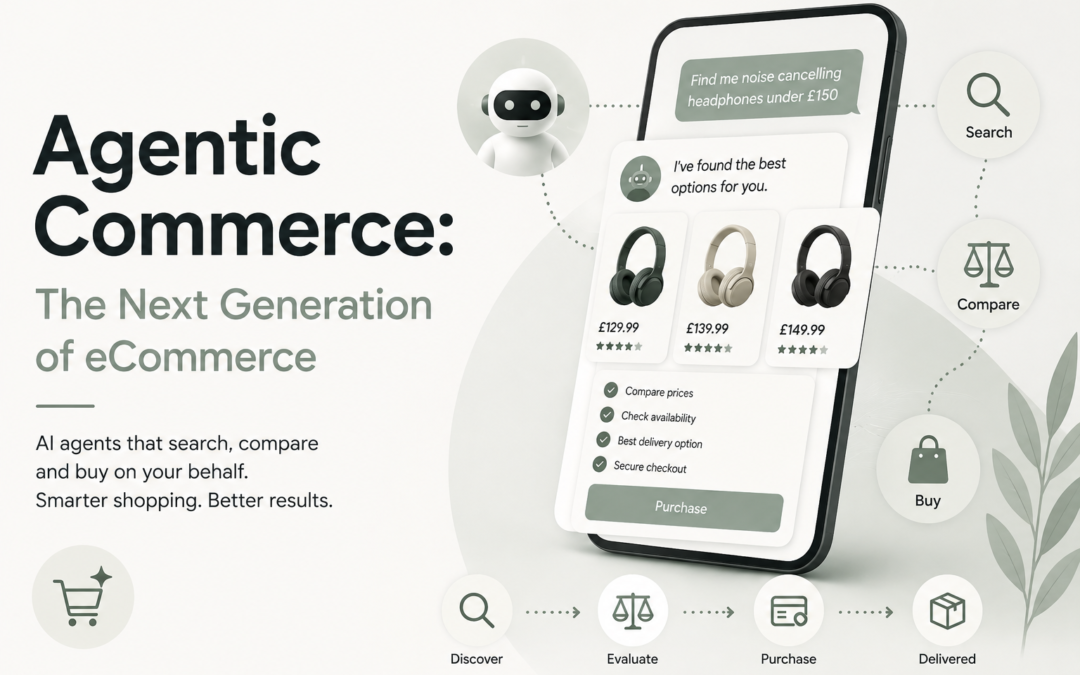
Instead of simply asking an AI platform for recommendations, a customer could ask it to find products that meet a set of requirements, compare suitable options, check availability and potentially help complete the purchase.
In many respects, agentic commerce is an evolution rather than a complete reinvention, building on many of the same foundations that good ecommerce websites already need today.
What is agentic commerce?
Agentic commerce describes the use of AI agents to carry out parts of the shopping process on behalf of a customer.
A traditional ecommerce journey might look something like this:
Search → website → product page → comparison → checkout
An agentic journey could become:
Request → AI researches products → AI compares options → customer selects → purchase
For example, instead of searching Google for “best waterproof walking jacket under £150” and opening several websites, someone could ask an AI assistant:
“Find me a lightweight waterproof jacket suitable for UK hill walking, available in large, with a budget of £150.”
The AI can potentially interpret those requirements, identify appropriate products, compare their characteristics and present a shortlist.
The important difference is that the customer is giving the AI an objective, rather than simply providing a search query.
Discovery is becoming more conversational
This change has actually started before agentic checkout.
People are already using ChatGPT, Google AI Mode, Gemini and other AI systems to research purchases and ask much more detailed questions than they might traditionally enter into a search engine.
Instead of:
acrylic sheet supplier
a customer might ask:
Where can I buy clear acrylic sheet cut to a specific size in the UK, with polished edges and holes drilled before delivery?
Those two searches contain very different amounts of information.
This has an important consequence for ecommerce websites.
Search visibility is increasingly about more than ranking a page for a collection of keywords. Platforms also need to understand exactly what a business sells, the attributes of its products, who those products are suitable for and under what circumstances they should be recommended.
Agentic commerce takes that development another step.
Shopify is already building for agentic shopping
Shopify has been moving quickly in this area.
Its Agentic Storefronts infrastructure is designed to make Shopify product catalogues available to AI shopping platforms, including ChatGPT, Microsoft Copilot, Google AI Mode and Gemini.
Shopify Catalog provides structured product information that these services can use for product discovery, while Shopify is increasingly bringing agentic commerce controls into Shopify Admin.
OpenAI is developing similar infrastructure through its Agentic Commerce Protocol, which allows structured catalogue information such as product descriptions, images, prices and availability to be supplied to compatible AI shopping experiences.
There is an important UK caveat, however.
At the time of writing, the full consumer agentic shopping experience is not generally available to UK shoppers. Some of the infrastructure is already relevant to Shopify merchants selling into supported markets, particularly the United States, but for most UK ecommerce businesses this is currently something to prepare for rather than urgently implement.
Your website is still the foundation
One misunderstanding about agentic commerce is that customers buying through AI will make the retailer's website less important.
I think the opposite is more likely.
AI systems need reliable sources of information from which to understand a business.
That includes:
- accurate product titles and descriptions
- well-defined product attributes and variants
- pricing and availability
- shipping and returns information
- structured product data
- authoritative supporting content
- clear information about the business itself
The website therefore becomes more than somewhere customers browse.
It increasingly becomes the authoritative data source describing the business and its products to both humans and machines.
That distinction matters.
AI agents cannot recommend what they cannot understand
This is where I believe much of the practical work around agentic commerce will take place.
Businesses will understandably focus on whether they are connected to ChatGPT, Gemini or another AI shopping channel.
But connection alone does not guarantee visibility.
An AI system still has to decide whether a particular product is relevant to a customer's request.
Imagine two websites selling technically identical products.
One describes the item as:
Pro Series 3000
The other clearly provides:
- product type
- dimensions
- material
- compatibility
- intended applications
- available variants
- delivery information
- technical specifications
The second product gives an AI shopping system substantially more information with which to determine when that product should be recommended.
This suggests an important shift in ecommerce optimisation.
Product data is becoming part of marketing.
Historically, attributes, specifications and feeds could easily be regarded as backend administration.
In an AI-driven shopping environment, they increasingly influence whether a product can be understood, matched to a customer's requirements and ultimately surfaced as a recommendation.
From keywords to product eligibility
There is another change that may prove significant.
Traditional SEO frequently asks:
How do we rank for this search?
Agentic commerce introduces another question:
How do we make this product an eligible answer to this requirement?
That is subtly different.
A customer might specify ten requirements in a single conversation:
Find me a particular type of product, in this size, compatible with this application, available within this budget and capable of being delivered by Friday.
The merchant whose product information allows an AI system to confidently verify those requirements has an advantage.
This is why structured product information, clear content and properly maintained feeds could become increasingly important.
Preparing for agentic commerce does not require starting again
The good news is that businesses do not need an entirely separate “agentic commerce strategy”.
Most of the sensible preparation is already good ecommerce practice.
A technically sound website should be easy for search engines and AI systems to crawl, products should be described clearly, important information should be represented through structured data, and product feeds should contain accurate and consistent information.
These principles are also part of the AI Visibility Framework I use when designing ecommerce websites: creating a strong technical and information foundation that supports traditional search, AI-powered discovery and emerging shopping channels.
Agentic commerce is another reason for doing this work properly, rather than a replacement for it.
Shopify may have an important structural advantage
There is also a broader reason why Shopify's developments are worth watching.
Shopify is not simply building an AI feature into individual stores.
It is building infrastructure that can connect a large catalogue of merchant products with multiple AI platforms.
Shopify Catalog effectively gives AI shopping services a standardised route to merchant data, while Shopify Checkout provides established commerce infrastructure when a transaction takes place.
That could remove a substantial integration burden from individual merchants.
Rather than every retailer having to build separate integrations for ChatGPT, Gemini, Copilot and future platforms, the ecommerce platform itself can increasingly act as the intermediary.
For smaller merchants in particular, that could make advanced AI commerce capabilities accessible much sooner than would otherwise have been possible.
What should UK ecommerce businesses do now?
For most UK businesses, I would not recommend making radical changes specifically for agentic commerce yet.
The technology and availability are still developing.
Instead, businesses can concentrate on fundamentals that already provide value today:
Make product information comprehensive
Include useful specifications, attributes, compatibility information and genuine answers to common buying questions.
Use structured data properly
Help search engines and AI systems identify products, organisations, FAQs and other important information.
Keep product feeds accurate
Prices, availability, variants and product attributes need to remain synchronised.
Create content around customer questions
AI shopping begins with natural-language requirements, so useful content should explain not just what a product is, but when and why someone might choose it.
Maintain a technically strong website
Crawlability, page performance and security remain fundamentals regardless of where the customer journey begins.
None of these changes depend on agentic checkout becoming available in the UK.
They improve ecommerce websites now.
The next stage of ecommerce, not the end of the website
Agentic commerce could eventually represent a significant change in how customers buy online.
Some purchasing journeys may increasingly begin — and potentially end — inside AI assistants.
But that does not remove the need for a well-built ecommerce website.
It changes one of its roles.
Alongside serving customers directly, an ecommerce site increasingly needs to provide a clear, structured and trustworthy representation of the business that search engines, AI platforms and shopping agents can understand.
The immediate objective therefore shouldn't be to chase every new AI commerce platform.
It should be to build ecommerce websites whose products and information are sufficiently well structured to work across whichever discovery channels emerge next.
That is useful for Google today, useful for AI search today, and increasingly likely to form the foundation of agentic commerce tomorrow.